
What to Do After an Arc Flash Study: Labels, PPE, and Training Requirements

Updated: Jul 17
Receiving your arc flash study report is a significant milestone for any facility. But for many safety managers and plant engineers, the real question surfaces right after: now what? The report identifies hazards, calculates incident energy levels, and defines arc flash boundaries for each piece of equipment. Turning those findings into an implemented, compliant safety program is the next step. This guide covers exactly what NFPA 70E and NEC require following an arc flash study, from equipment labeling and PPE selection to employee training and long-term maintenance.
Understanding Your Arc Flash Study Deliverables
When Herzig Engineering completes an arc flash study, you receive a set of engineering deliverables that document the electrical hazard landscape across your facility. Understanding what is in each document helps you prioritize implementation.
The core deliverables include the arc flash hazard report, which summarizes incident energy levels and arc flash boundaries at each panel, switchgear, and motor control center. You also receive a fault contribution study showing available fault current at key points throughout the system, one-line diagrams mapping your electrical distribution network, and equipment-specific PPE and labeling recommendations tied directly to the study results.
The cal/cm2 number on your report tells you how much thermal energy a worker could absorb in the event of an arc flash at that specific piece of equipment. That number directly determines the PPE category and arc flash boundary required for anyone working near it. For a deeper look at how those numbers were generated, our arc flash study process guide walks through each step of the analysis from data collection to final report.
Arc Flash Labels: What NFPA 70E and NEC Require
NFPA 70E Article 130.5 and NEC Section 110.16 both require that electrical equipment likely to require examination, adjustment, servicing, or maintenance while energized be field-marked to warn of potential arc flash hazards.
Labels must be applied before any energized electrical work resumes. This is not optional. An unlabeled panel where the incident energy has already been calculated is a compliance gap that puts both workers and employers at risk. As part of every arc flash study, Herzig Engineering prints and applies NFPA 70E and NEC-compliant labels during a second on-site visit. Each label is equipment-specific and built from the actual results of your study, not from generic templates.

What Must Be on an Arc Flash Label?
Per NFPA 70E, each arc flash label must include the following information for the specific piece of equipment it is attached to:
1. Nominal system voltage
2. Arc flash boundary
3. Incident energy at working distance (in cal/cm2)
4. Corresponding PPE category or cal/cm2 value
5. Working distance used in the calculation
6. Available fault current
7. Date of the arc flash study
This level of specificity matters because arc flash hazards can vary significantly from one piece of equipment to another, even within the same facility. Labels must reflect the conditions and calculated hazard level for the specific equipment they are applied to, ensuring workers have accurate information for hazard assessment and PPE selection.
Selecting PPE Based on Your Study Results
One of the most practical outcomes of an arc flash study is a clear, equipment-specific PPE roadmap. The study identifies the arc flash hazard level for each piece of equipment and provides the information needed to determine the appropriate level of protection for employees performing energized work.
NFPA 70E provides four PPE categories that establish minimum arc rating requirements for certain tasks and equipment conditions:

Category 1: 4 cal/cm2 minimum arc rating. Arc-rated long-sleeve shirt and pants or coverall, face shield, and safety glasses.
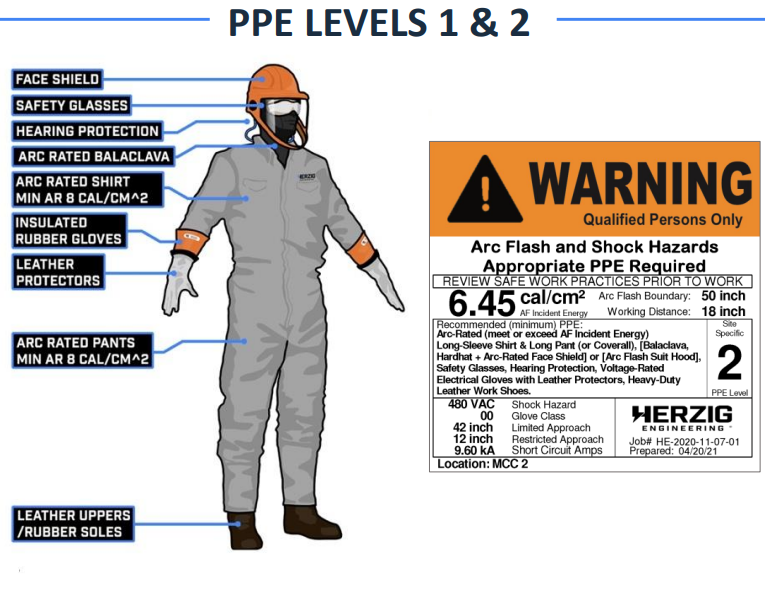
Category 2: 8 cal/cm2 minimum arc rating. Arc flash suit hood or arc-rated face shield with balaclava, arc-rated clothing system.

Category 3: 25 cal/cm2 minimum arc rating. Arc flash suit with hood, arc-rated gloves, and layered arc-rated clothing.
Category 4: 40 cal/cm2 minimum arc rating. Full arc flash suit with maximum arc rating, face shield, and arc-rated gloves.

Many industrial facilities see a range of categories across their equipment, which is why PPE selection must happen at the equipment level, not the facility level. A worker suited for Category 1 work near a small branch panel is not adequately protected at a Category 3 switchgear lineup. Your arc flash study report provides the category for each piece of equipment so there is no guesswork involved.
Because Herzig Engineering does not sell PPE, the recommendations in your study are completely unbiased. The report reflects what the incident energy requires, with no incentive to recommend higher-rated gear than the data supports.
NFPA 70E Training Requirements After an Arc Flash Study
Completing the study and applying labels addresses hazard identification and communication. Training is the third element of a compliant electrical safety program and the one most directly tied to whether workers can use the study results safely.
NFPA 70E Article 110.4 requires that employers ensure workers are trained to understand the electrical hazards they may be exposed to, at intervals not to exceed three years. After a new arc flash study, training should be updated any time the study reveals new or changed hazard levels that affect PPE requirements or approach boundaries for specific equipment.
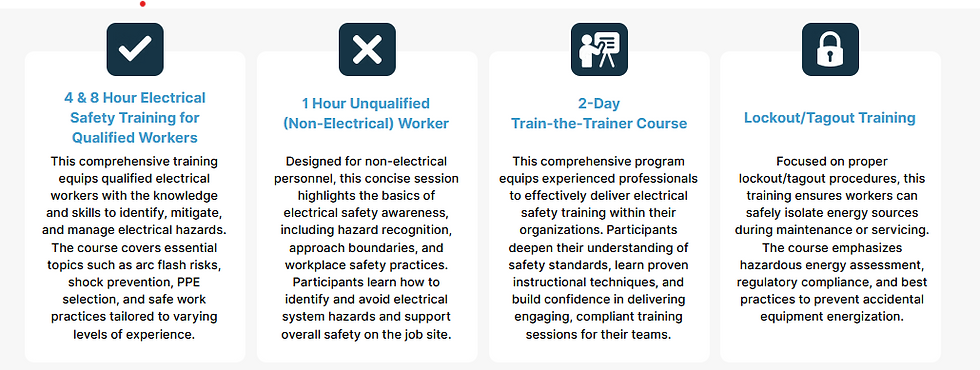
Training requirements differ based on worker role. Qualified workers, those who perform electrical work as part of their responsibilities, such as electricians, maintenance technicians, HVAC personnel, and engineers, require a 4-hour or 8-hour electrical safety training course covering arc flash risks, shock prevention, PPE selection, and safe work practices. Unqualified workers, meaning non-electrical personnel who may work near energized equipment, require a 1-hour electrical hazard awareness session covering hazard recognition, approach boundaries, and basic avoidance practices.
Every arc flash study from Herzig Engineering includes a complimentary NFPA 70E training session, delivered either on-site or through the Herzig+ online platform. Herzig+ allows employees to complete training at their own pace and gives safety managers a straightforward way to track compliance and renewal schedules across the organization. See below for some of the training services offered at Herzig Engineering:
Updating Your Electrical Safety Work Practices
A new arc flash study often reveals changes in incident energy levels compared to previous assessments. When that happens, applying updated labels is the starting point, not the finish line. The following work practices should be reviewed and updated to reflect the current study findings.
Energized Electrical Work Permits (EEWP): If your facility performs energized electrical work, each task requires a documented justification per NFPA 70E. The permit process should reflect the updated hazard levels from the new study, including any changes to required PPE or arc flash boundaries.
Approach boundaries: Safe approach distances for both shock and arc flash hazards are defined in the study. These boundaries should be clearly communicated to all workers who may be near energized equipment, not only those performing electrical work.
Lockout/tagout integration: Arc flash studies frequently identify equipment where the preferred approach is de-energization rather than energized work. When that recommendation appears, it should prompt a review of the facility's lockout/tagout procedures to confirm that the LOTO program covers the newly identified equipment and aligns with the updated one-line diagrams.
Taking these steps closes the gap between having a study on file and running a functional, NFPA 70E-compliant electrical safety program.
When to Schedule Your Next Arc Flash Study
An arc flash study is not a one-time document. NFPA 70E Article 130.5 requires that arc flash risk assessments be reviewed at intervals not exceeding five years. More importantly, the standard also requires a review whenever major changes to the electrical system occur, regardless of when the last study was completed.
Common triggers for an early review include the addition of new electrical equipment such as switchgear, panels, or motor control centers; transformer upgrades or replacements that change available fault current; modifications to protective device settings including breaker and relay adjustments; and facility expansions or new production lines that alter electrical load and system configuration.
Even changes that seem minor on the surface can shift incident energy levels enough to affect PPE categories and label requirements. Building a scheduled review cadence into your facility's safety program, rather than waiting for a specific trigger event, is the most reliable way to stay compliant and keep workers protected. For facilities with multiple locations or high equipment turnover, Herzig Engineering offers corporate arc flash programs designed to coordinate study schedules and maintain consistency across sites.
Get Help Implementing Your Arc Flash Study Results
For more than 25 years, Herzig Engineering has helped facilities across the country move from study completion to full program implementation. Whether you need labels applied, training scheduled, or a LOTO program review following your most recent arc flash study, our team is ready to support the next step. Contact Herzig Engineering today to request a same-day quote or speak with one of our electrical safety engineers at 816-734-8300.


Comments